Monday, 25 February 2013

February Happenings

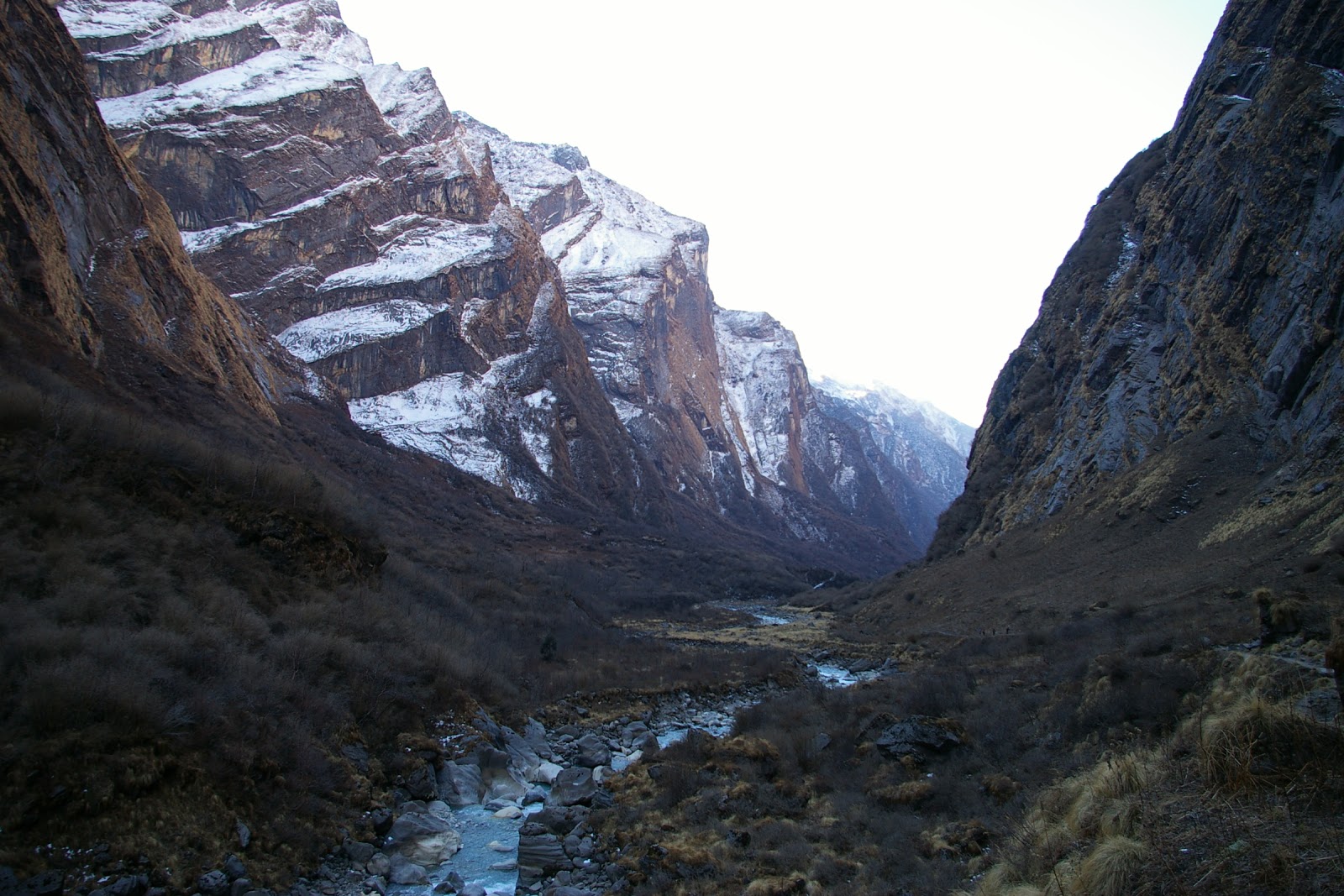
Just a little reminder of part of our view. This is Annapurna II and IV with a recent fall of snow.

These are pictures of our farm visit. We are standing in the centre of the buildings. The brick place in front of us has chickens in the top floor and baby buffalo in the bottom. (The top of the slope in the background is the level of the hospital and school.)

This building was out of shot to the right in the previous photo. The buffalo are brought back here each afternoon after they have been grazing around the hospital grounds and are then milked by hand and fed.
This one was tethered separately- not sure why. That rope goes right through the nose, in the same place as the bull's rings on N.Z. farms. It must give their handlers a little leverage when they want to take control. The buffalo are quite wild and we are very cautious when we meet them on the street, particularly within the narrow confines of our lane for example. They have a mind of their own and will take off not minding whatever is in their path. There is a story told over here of Tony's close encounter with one early one morning and arriving at school ashen faced.
Rice straw is trucked into Pokhara from surrounding areas and made into a  big kind of haystack around a pole or the trunk of a tree. This is a chaff cutter driven by an electric motor. It cuts this rice straw up both as mulch for the mushrooms grown on the farm and for buffalo food.  We were surprised at the amount of straw they fed through at once, but obviously the teeth are very sharp.
My Dad used to talk about motors at times sounding 'like an old chaff cutter'. I now know exactly what he meant.

The farm has pigs, goats and rabbits as well as buffalo and chicken. They had quite a few breeding sows with good sizable litters. A big sow like this had her nose right up to another gate which greatly intrigued the children. I was watchful they didn't poke their fingers too close though. The stys were very clean and had little smell, but some of the children were holding their noses as they walked around. Clearly townies!


The farm is quite extensive. We understand that it is on the original site, but later when an adjacent block of land became available, at a slightly higher elevation, this was purchased for ongoing hospital work and the lower land, which does not catch the breeze the same, was used for the farm. This view looks almost directly across to the airport and the lower view has the side of Sarangkot in the background. You may be able to see the surveyors working on the bare land.  This is to be the site of new and enlarged  chicken sheds.

All the veges looked so healthy. They are all organically grown and get lots of buffalo and chicken poo . The patients work on the farm. They grow cauli, broccoli, cabbage and a big long white radish outside. Inside the houses are bean and tomatoes. We bought some veges and they were so fresh and crunchy. There is a block up shops right up at the gate near the school which have just been completed. One of them is going to sell farm produce, so we will be able to buy eggs and veges more easily.


These are the wedding shots. The top one is with Shrison and this one is the Garambesi contingent. Hard to recognise those who came to carry out packs!

These are from the first wedding we went to. Note the distance between the bride and groom and the expressions on their faces. Even the dancing evoked no real response.


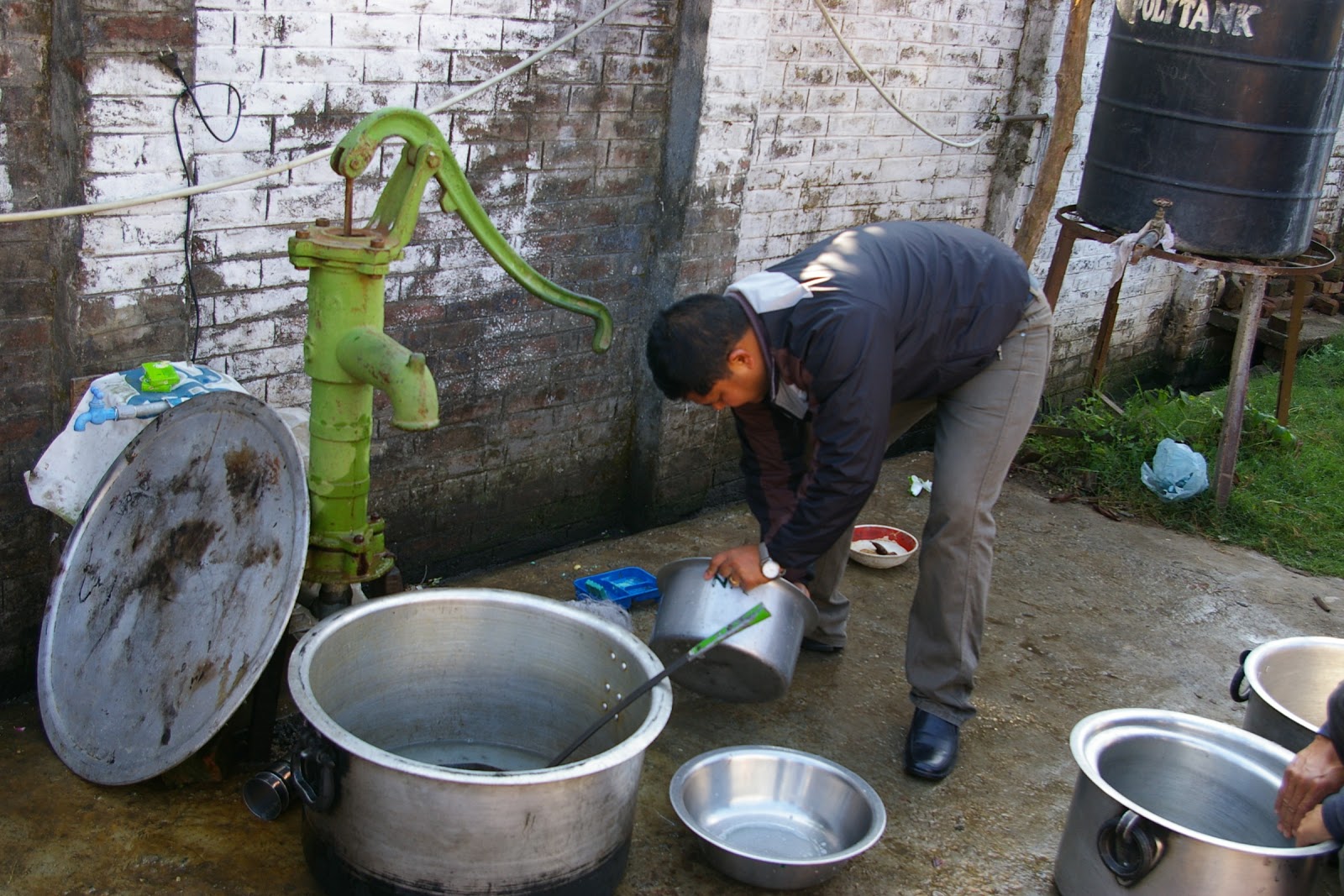
These are pictures from the second wedding. That is Sue beside me busy chopping veges and below is Dinesh washing out the pots at the pump.


This is where all the food was cooked in the open shed. The chicken cages are above the shoulder of the person in blue. You can get some idea of the large quantities of food that are prepared.
A close up shot of the cooking arrangements.
Sorry this is a very blurry picture, but have included it so that you can see the differences between the two services. This was a more relaxed service in every way, but the same protocols re showing emotion and looking at each other were evident.


Saturday, 26 January 2013

Kathmandu

Unfortunately we didn't take many pictures while we wandered around Kathmandu. However we saw this site from the footpath as we walked past. We are not sure why monkeys are associated with temples but wonder if it is because of the food being offered there. We did notice lots of banana skins on the footpath nearby.
This is one of the temples at Bhaktapur. The city has been rebuild with German money after it was destroyed by earthquake. We had to pay a fairly hefty fee to get into the square and then another fee for a guide. However he did draw out attention to the fact that the profile of the roof mirrors the shape of the Nepali flag.


This was the main part of the potters square and you can see all the pots leathering awaiting bisking. In the top picture the woman appeared to be painting the top half of each vessel presumably with glaze or stain of some kind.
 This potter was out in the main square doing his craft. He has a notch in his wheel to get it started. As soon as he realised we were watching he raised his head and yelled "Money". This is the normal kind of wheel they use.
Ken was intrigued to watch this man pugging his clay. He thought it was quite a bit to be handling at once especially by hand like this.

 This is where they were firing. You can see wisps of smoke escaping. There is straw underneath covered by ash. There were at least four piles like this all smoldering away.
This is the clay they all seemed to be using. The firing temp is very low around 600-800.


This potter was able to speak English and Ken spent quite a bit of time with him. He starts the pugging process by belting his clay with a sledgehammer. He has made his own wheel from a truck tyre and spins it with the stick before he starts work. Most of his vessels were quite small though.
This is made on an electric wheel- not sure how they manage to produce much because the power supply in Kathmandu is even more erratic and infrequent than Pokhara. However he had a good stack of these vessels in his shed. 


One of the nicer things we saw for sale there.


These pictures are all from the pottery place that supplies goods to the Fair Trade shop, Dukuti. While we watched this woman made several bowls, all the same size and dimension. She was very quick and skillful and is apparently one of their best potters- more than 20 year experience. Her wheel is electric and we were not aware of them having a generator of their own.

 This is Ken and the master potter and factory manager discussing clays, firing temps etc. This place blend two clays together  (local terra-cotta and imported Indian stoneware) and fires at about 1200.
 This is their trial kiln- electric, but their main kiln is gas.
Ken found a piece that was glazed with ash (pointing to it) so there was great discussion about his onion ash work and what kinds of materials (e.g. bamboo) they could use to get similar effects. The ash in this case was rice straw ash.

Friday, 4 January 2013

Annapurna extra

We have been checking our photos and realise we should have put this one on. It is a view of Machhapuchhre from just above Annapurna Base Camp. We think it is probably our favourite of the trip.

Annapurna Sanctuary

..This is Jum, our porter, standing in the grounds of the Australian Camp. Immediately behind is Machhapuchhre with Annapurna IV and II to the right.
 In the valley of the Modi Khola approaching Landruk. Annapurna South in background.

 Enroute from Landruk to Chomrong, almost down to the Modi Khola.
 Views across to the other side, Jhinudanda partway up and Chomrong at the top of hill to the right of picture.
Crossing the Modi Khola on the longest swing bridge - 127 steps.
Some of the rice paddies across the valley.
Looking down from the path up to Chomrong. Blue roofs of Jhinudanda below and the Modi Khola along the valley floor.

Machhapuchhre at sunset on Christmas Eve from Chomrong.

 There were lots of these little resting places at the top of steep runs. Just the right height to put the pack on.
 Looking up the valley from Sinuwa.
 This arrangement of poles,stones, mud and grass was to provide a pathway round a rocky bluff.
 And another of the bridges! Who knew what was beneath.
 The path from Bamboo to Dovan, climbing but only slightly.
 Above Dovan we really started to climb.
 Icy waterfalls on the valley wall opposite above Dovan
 And more track, near Himalayan Hotel
 This is known as Hinku Cave and is not far below Deurali.

The path down to the river below Hinko Cave
 Preparing to cross the river....


Upward and onward on the final scramble to Deurali. We got lots of comments about our age and this Japanese man decided he needed a picture with me.
 The lodge at Deurali-
....... and the view from the terrace.

 Views of the river above Deurali.
 Looking back down the valley from above Deurali.
 Avalanche debris below Machhapuchhre Base Camp.

 Checking with others who had been with us but travelled on ahead and were now returning. Just below MBC.
 MBC- the same height as Mt Cook.
 Looking back down the path from MBC


 These are all views ahead as we trekked on towards Annapurna Base Camp.

 Some of the delightful scenery on the way.
 ABC at last 4100m!!!
 Views from behind base camp..
 ......at sunset.
 Sun rising behind Machhapuchhre the next morning.

 Daphne- which scented our way in the lower regions.